
Clip papers into cards. Understand them one by one.
Every card remembers where it came from.
No credit card needed. The free plan parses 3 papers a month.
Why read papers with Clipaper
Cards that follow the paper
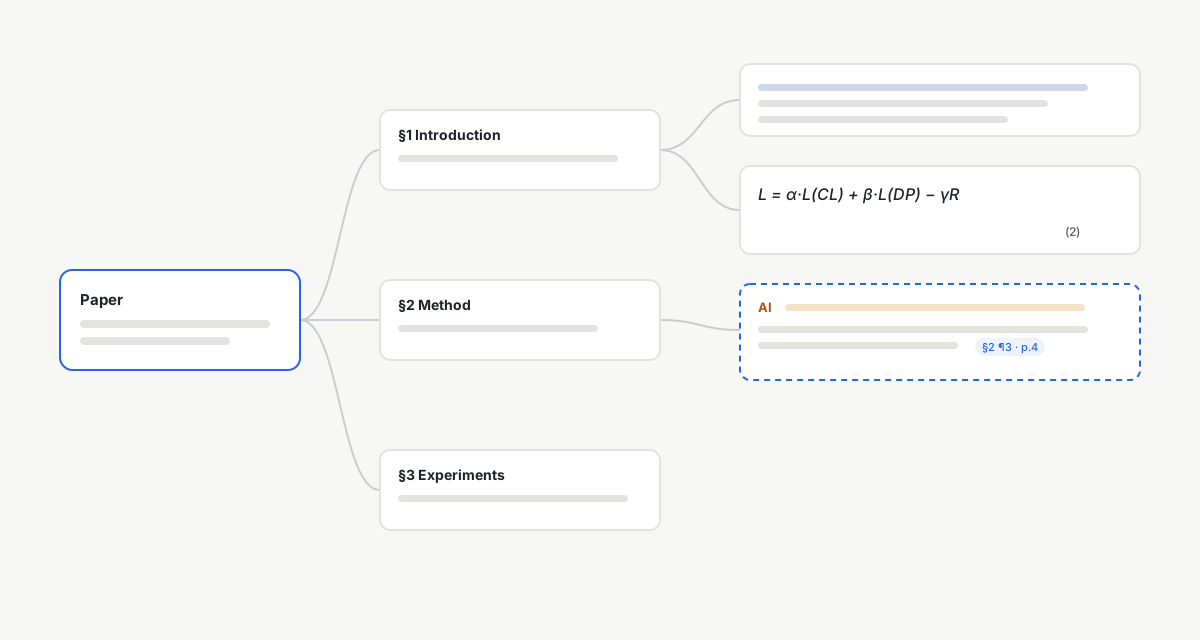
Sections, paragraphs, equations, figures, theorems and references each become a card, laid out on a board in the paper’s own hierarchy. Skim titles and summaries first, then open what you need to read closely.
Translation, card by card
Every card comes with a translation, so you can compare the original and the translation one card at a time, with formulas and terms kept intact. Stuck on a card? Ask the AI to explain it in plain words, or ask a question about it.
Back to the exact paragraph
Each card links back to its paragraph in the original PDF. Every claim in an AI answer cites where it comes from in the paper, so you can check it with one click before you cite it.
Three steps to start
- 1
Add to your library
Drop in a PDF or paste an arXiv link. Clipaper fills in the title, authors and year.
- 2
Parse into cards
Papers with arXiv source are parsed from the source for more accurate formulas and numbering; others are read page by page from the PDF. It takes a few minutes.
- 3
Read on the board
Open, fold and move cards, write notes, use Focus to concentrate on one section, and switch to the original PDF whenever you need it.
We start with English-language papers in computer science, physics and mathematics.
What the free plan includes
- Parse 3 papers a month (up to 40 pages each), with translations and summaries for every card
- 50 credits a month for AI questions and explanations
- Unlimited library items, folders, notes and Focus boards
- 2 GB of storage, and you can export all your data at any time